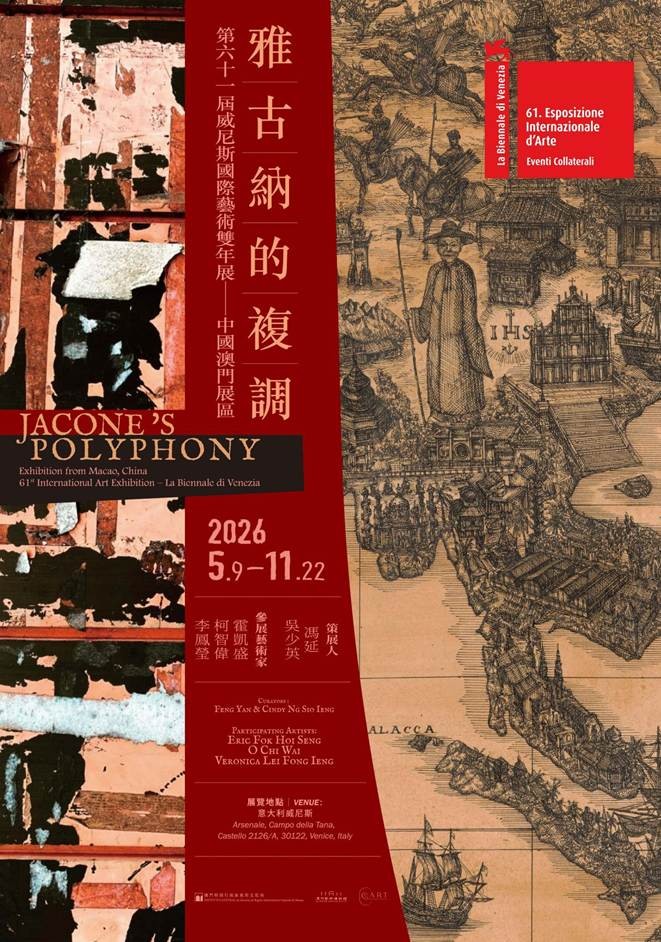
Curators : Feng Yan, Cindy Ng Sio Ieng
This contemporary art exhibition presents a narrative inspired by the life and cultural practices of Wu Li, one of the ‘Six Masters from the Early Qing Dynasty’. It also attempts to symbolically complete his unfinished journey to Europe over 300 years ago. A pioneer of cross-cultural exchange in the late Ming and early Qing dynasties, Wu travelled to Macao, intending to continue onward to Rome with missionaries during the reign of Emperor Kangxi. However, the voyage was never realised.
In Macao, Wu adopted the Portuguese name and later wrote San Ba Ji (Collection of Poems about St. Paul's). Returning to Jiading and Shanghai to spread his faith, he reimagined Western hymns in the traditional Chinese sanqu form. Wu’s experiences in Macao made him a key figure in cultural integration between East and West.
The exhibition presents a linear account of Wu Li’s life and Macao’s cultural fusion. Artists Eric Fok Hoi Seng, O Chi Wai, and Veronica Lei Fong Ieng deconstruct Wu’s spiritual space from a contemporary perspective. Artworks are arranged in a closed loop, creating a progressive journey that bridges Macao and the international art community, prompting reflection on historical fragments and cross-cultural identities.
This exhibition examines history and explores Macao’s cultural roots while also showcasing the city’s innovative spirit and inclusivity in fostering cultural integration. By investigating the flow and fusion of culture within globalisation, the exhibition resonates with the theme of the 61st International Art Exhibition – La Biennale di Venezia.
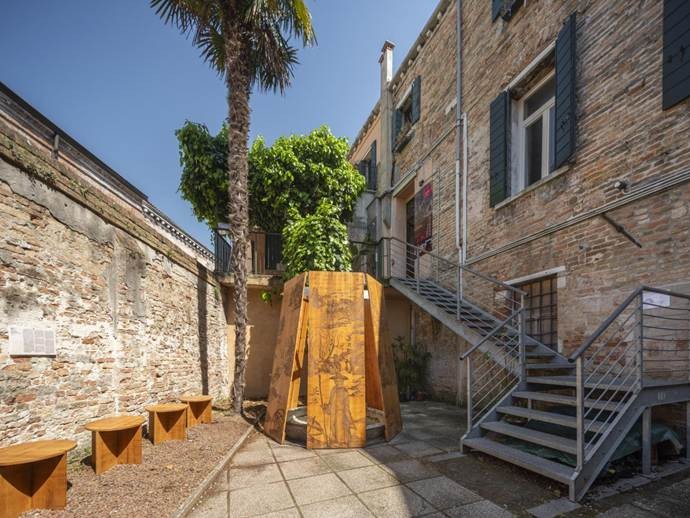
Layers of Time Eric Fok Hoi Seng Bamboo steel, metal, laser engraving 210 x 160 x 247 cm 2026
Wu Li adopted the pseudonym ‘Mojing Daoren’, meaning ‘Practitioner of the Ink Well’. The name refers to a legendary well at his former residence, believed to have once belonged to Yan Yan (c. 506–443 BCE), also known as Ziyou, a disciple of Confucius. The well was said to be so deep and dark that its water looked like ink, and it was known as the Mojing, or ‘Ink Well’. Inspired by this site, Wu Li chose the pseudonym Mojing Daoren to express both his attachment to his hometown and his identity as a scholar-artist rooted in classical tradition.
In the exhibition space, this idea is reimagined through a circular pool that evokes the original well. Surrounding it are six panels made of bamboo steel, combining traditional Eastern materials with industrial ones to create a contemporary interpretation of the Mojing. Drawing on Wu Li’s life before his departure for Macao, Eric Fok distills key moments of his journey into a visual map, rendered in his narrative painting language and laser-engraved onto panels.
Arranged in a circle, the six images invite the audience to move around the installation in a ritual-like encounter across time. Light and shadow reflected in the pool interact with engraved imagery, creating a layered visual field that suggests the flow of time and the accumulation of memory. In this way, visitors become participants in a living historical dialogue, helping to reactivate and carry forward Wu Li’s spiritual and artistic legacy as they move through the exhibition.
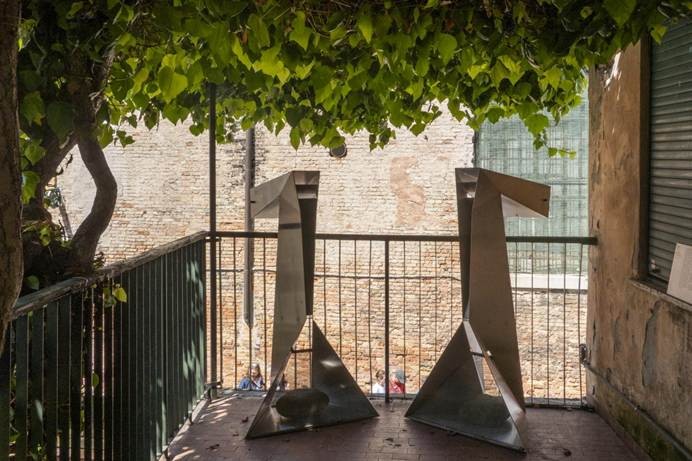
Distant Views Eric Fok Hoi Seng Metal, painting on acrylic sheets 75 x 74.5 x 155 cm x 2 2026
The invention of the telescope not only transformed global maritime exploration and cross-cultural exchange, but also carries powerful associations with observation, searching, and connection. Using the telescope as a starting point, the artist embeds painted lenses into two instruments, each depicting scenes of historic Macao and Rome.
The Rome-themed telescope faces the entrance to the Venice Biennale’s main exhibition hall, echoing Wu Li’s lifelong dream of travelling to Europe. The Macao-themed telescope turns towards the opposite wall, reflecting the path Wu never completed – one marked by uncertainty and the unknown.
This bidirectional viewing design translates Wu Li’s inner tension between aspirations and constraints into a tangible physical experience. By reimagining the telescopes as contemporary art objects, Fok questions the role of contingency and necessity in historical narratives and how individual lives unfold within a cross-cultural context.
Installed on the balcony of the exhibition area, the work invites visitors to pause and experience it, forming a visual bridge between viewers and Wu Li’s journey across time and place.
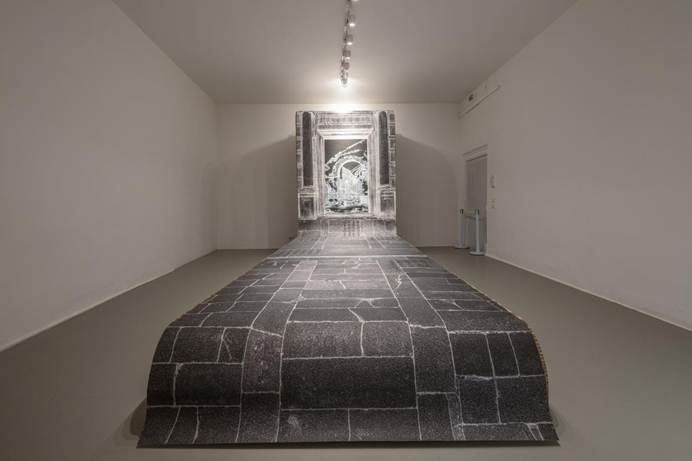
Floating Stones Eric Fok Hoi Seng Giclée print, painting, high-strength corrugated cardboard 182 x 645 x 285 cm 2026
The artist grew up studying near the Ruins of St. Paul’s in Macao, creating an unexpected overlap with the life of Wu Li, who walked the same streets and visited the former cathedral more than three centuries earlier. Taking this shared geography as his starting point, Fok has carefully reproduced the textures of the church’s porch and stone steps, transferring them onto a large sheet of rice paper. Suspended from an installation structure, the paper appears to float mid-air in the exhibition hall, reconstructing the site’s architectural memory.
On a narrative level, Fok draws on Wu Li’s life and education in Macao, translating them into his own visual language. Aspects of Wu Li’s uncertainty and contemplation during his years of study are woven into the blank spaces of the scroll-like surface. Through this interplay of historical reference and contemporary interpretation, the work traces Wu Li’s inner transformation and the reshaping of his identity during his time in Macao.
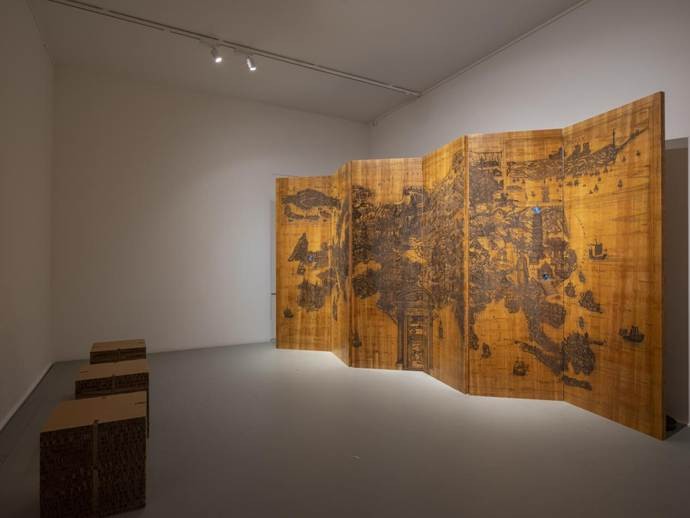
Silent Travelogues Eric Fok Hoi Seng Bamboo steel, digital screens, laser engraving 390 x 225 cm 2026
This work centres on the idea of historical absence, imagining the path Wu Li never took – his unfinished journey to Rome. Drawing on the travels of Michael Shen Fu-Tsung – a Chinese administrator and Jesuit who successfully reached Europe during the same period – as a historical reference point, Fok establishes a framework for Wu Li’s unrealised route. The artist constructs a visual narrative that marks the encounters, tensions, and cultural crossing Wu Li might have experienced, rendered in a form that recalls a nautical map.
The installation takes the form of a screen constructed from bamboo steel, with laser-engraved painted imagery. More than a physical partition, the screen functions as a metaphorical boundary between past and present, and between East and West. Four openings, conceived as ‘historical gaps’, puncture its surface. Using AI-generated innovations, Fok transforms Wu Li’s real and imagined routes into moving images. Through these historical gaps filled with imaginative narratives, visitors are able to view Wu Li’s journey more intimately.
By bringing imagination into dialogue with historical absence, the work reflects on contingency and possibility in individual lives within larger historical narratives. Guided by the dialectical logic of the spatial design, the installation explores the boundaries and the interdisciplinary questions that emerge from cross-cultural exchange. It embodies a spiritual dialogue that spans more than three centuries.
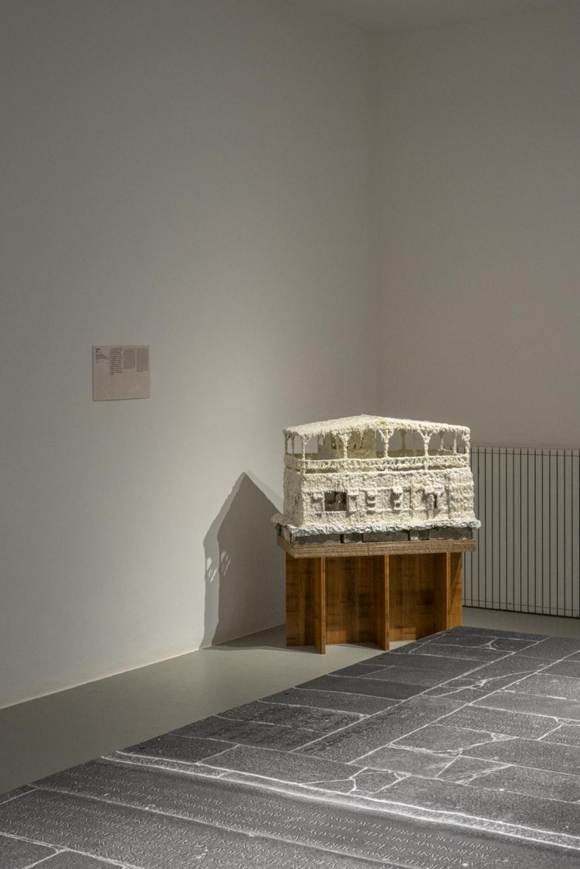
Sigh of Migration Veronica Lei Fong Ieng Candles, aluminium foil, bamboo steel 88 x 41 x 110 cm 2026
Like Wu Li, Veronica Lei is both a Catholic and an artist, and she has chosen Rua dos Curtidores – the place believed to be Wu Li’s first residence in Macao – as the site of her studio. She turns the architectural space itself into part of her artistic language, a place where time, space, and spiritual history interact. Building on this foundation, Lei uses aluminium foil to construct models of the studio building and drips wax from candles onto them, creating a delicate, ephemeral form that evokes the passage of time and the spiritual migration. Through this body of work, Lei explores possible connections between fragmented histories and contemporary memories, echoing individuals’ quest for spiritual grounding amid cultural migration and change.
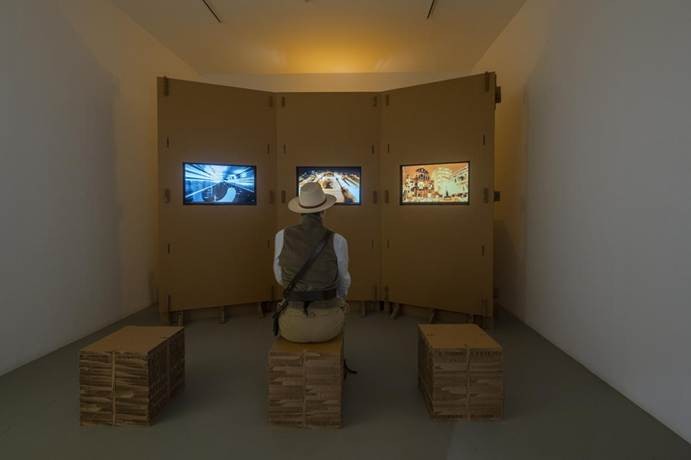
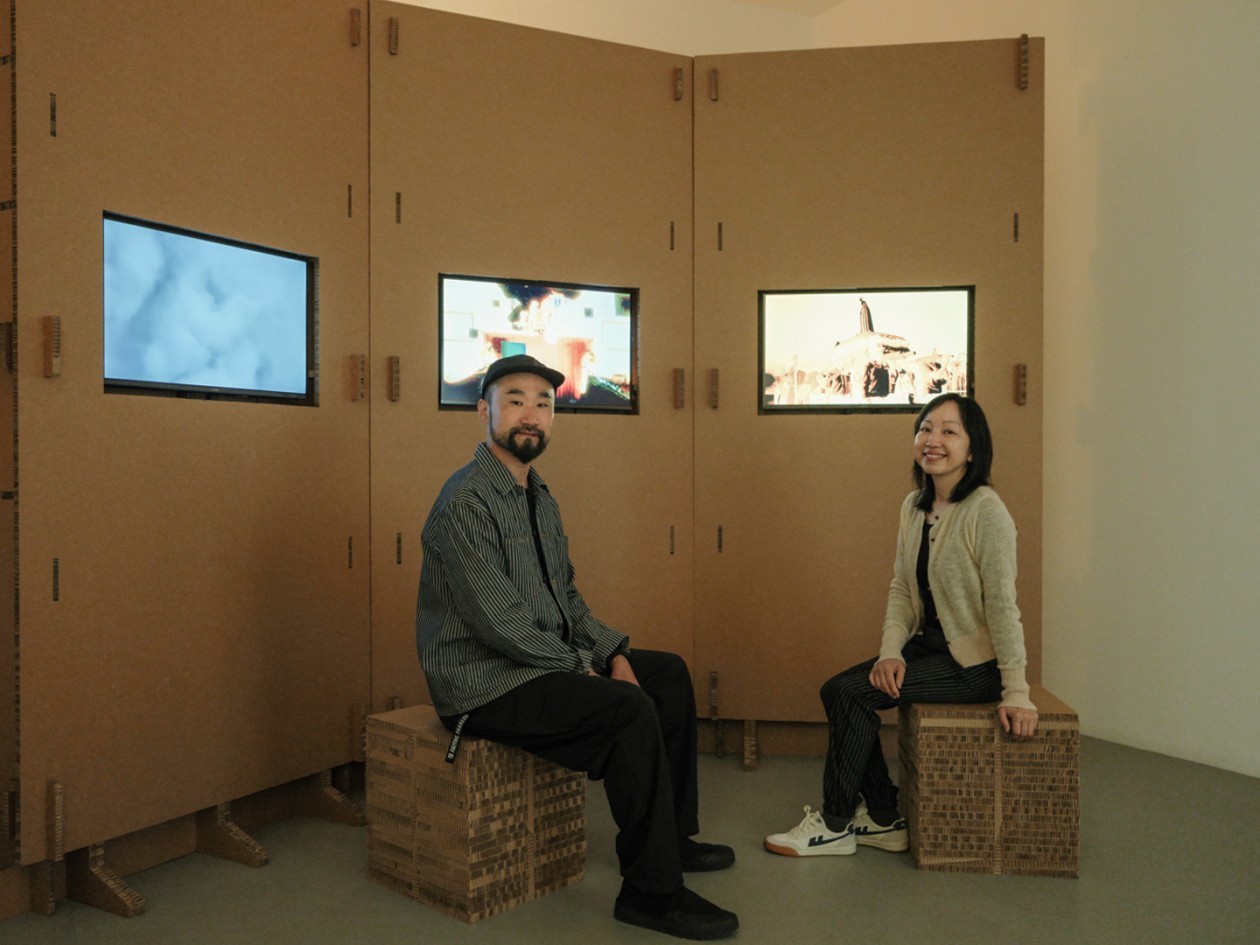
Sanqu (A Cappella Reverie) O Chi Wai 5-minute video footage, digital screens, high-strength corrugated cardboard 377 x 225 cm 2026
O Chi Wai approaches Wu Li’s life as a creative path to be traced – both physically and imaginatively – through walking, research, and visual storytelling. By gathering local memories and interpretations of Wu Li in each place, he integrates personal experience and collective memory into a single creative vision.
Working with Water Singers, a Macao-based music group, the artist reinterprets the spirit of cultural exchange and mutual learning embodied in Wu Li’s work, Tianyue Zhengyin Pu (Compendium of Orthodox Sounds of Heavenly Music). The collaboration gives Wu Li’s legacy a contemporary poetic form, expressed through a modern interpretation of sanqu, a fixed-rhythm form of Chinese lyric poetry.
The installation is presented as a triptych, with synchronised video displayed on three screens. The triptych resonates Wu Li’s religious background, and its three-part structure allows the exhibition space itself to become part of the narrative. Together, the screens create a layered, immersive historical field.
By drawing on Wu Li’s cross-cultural life and experiences, the work explores the diverse possibilities of identity in a globalisation context – addressing the question of cultural exchange through artistic practice. In doing so, it offers a contemporary activation and creative continuation of Wu Li’s spiritual and artistic legacy.